
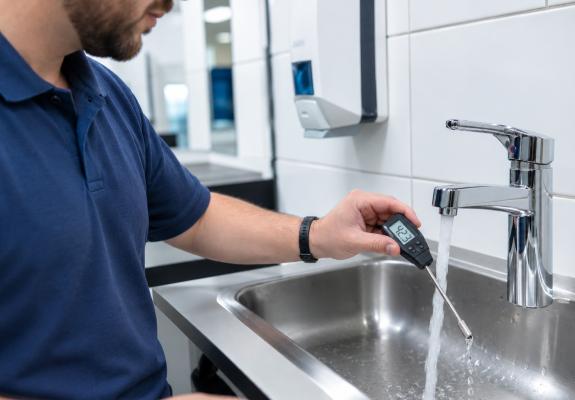

Two terms, one water system and an important distinction. In Legionella management, “duty holder” and “responsible person” are often used interchangeably, but they describe different responsibilities. Understanding the difference helps organisations establish clear arrangements and maintain effective control of water hygiene risks.
In simple terms, a duty holder has relevant legal health and safety duties, while the responsible person is the competent person, or people, appointed to manage the identified Legionella risks on a day-to-day basis.
What is a Legionella duty holder?
The duty holder is the employer, self-employed person or person in control of premises or water systems to whom relevant health and safety duties apply. Depending on the circumstances, this may include a landlord, managing organisation or another party with control over the premises or systems. More than one party can have legal duties.
A duty holder must ensure that the risks are suitably assessed and that appropriate arrangements are in place to prevent or control exposure. They can appoint competent staff and engage specialist contractors, but doing so does not remove their own statutory responsibilities. Other parties, including contractors, may also have legal duties relating to the work they undertake.
What is a Legionella responsible person?
ACOP L8 describes the responsible person as a competent person, or persons, appointed to take day-to-day responsibility for controlling identified risks from Legionella bacteria. They need sufficient authority, knowledge of the water systems, skills and experience to perform the role effectively.
In practice, this means coordinating the control scheme, checking that planned monitoring and maintenance take place, reviewing results and ensuring that problems are investigated, acted upon and escalated appropriately. The responsible person does not necessarily carry out every temperature check or maintenance task personally.
Duty holder vs responsible person: the key differences
| Aspect | Duty holder | Responsible person |
| Who they are | Employer, landlord or another person or organisation with relevant statutory duties | Competent person or people appointed to oversee day-to-day Legionella control |
| Primary role | Ensure risks are assessed and suitable management and control arrangements are established | Coordinate and oversee implementation of the identified control arrangements |
| Delegation | May allocate work but retains their own statutory duties | May allocate tasks while maintaining oversight within the appointed role |
| Legal position | Duties arise under applicable health and safety legislation | Appointment is addressed by ACOP L8 and HSE guidance |
Can the duty holder and responsible person be the same person?Yes. A duty holder can also be the responsible person, provided they have the competence, authority, resources and time needed to manage the risks effectively. For a small organisation with straightforward systems, this may be a practical arrangement.
Larger estates or complex water systems may benefit from several appointed responsible persons, local coordinators or clearly defined deputies. There is no universal rule requiring the roles to be held by separate individuals simply because an organisation is large or operates multiple sites. What matters is that responsibilities are clear and the arrangements are effective.
What does the responsible person actually do?
Oversees the written control scheme and makes sure planned monitoring, inspection and maintenance are carried out.
Reviews results and records, identifies failures or trends, and ensures corrective actions are assigned and followed through.
Makes sure those carrying out tasks understand their responsibilities and are suitably trained or instructed.
Escalates significant issues to the duty holder or relevant decision-maker when additional resources or authority are needed.
Coordinates relevant parties, including contractors and building management teams; in more complex settings, this may include participation in a Water Safety Group.
Accurate records provide evidence that control measures have been implemented and help identify emerging problems. The level and type of monitoring should follow the risk assessment, written scheme and relevant technical guidance.
What training and competence does a responsible person need?
A responsible person must be suitably informed, instructed and trained. There is no single universal qualification that makes someone competent for every site or system. Competence depends on the nature of the water systems, the risks involved, the person’s experience and their ability to manage the required control measures.
Training should be kept relevant as systems, legislation, guidance and responsibilities change. Organisations should maintain suitable evidence of appointments, training and competency, and make sure the responsible person has the authority and resources needed to act.
Deputies and continuity
What happens when the responsible person is away, changes role or leaves the organisation? Legionella control measures must continue, so organisations should put appropriate cover and handover arrangements in place.
A named, competent deputy can be a particularly useful arrangement, especially across large or complex estates. Although ACOP L8 does not impose a universal requirement to use the title “Deputy Responsible Person”, responsibilities and cover should remain clearly allocated so monitoring, corrective action and escalation do not fall between the gaps.
Can you outsource the responsible person role?
Yes. HSE guidance allows one or more competent people from outside the organisation to be appointed where appropriate. The scope of the appointment, decision-making authority, reporting arrangements and communication routes should be agreed and understood.
However, appointing a water hygiene contractor to carry out risk assessments, sampling, temperature monitoring or remedial works does not automatically make that contractor the responsible person. Specialist service delivery and a formal responsible person appointment are different arrangements. The duty holder must still satisfy themselves that the overall risk management arrangements are suitable and effective.
Why getting these roles right matters
Even a technically sound risk assessment and control scheme can be undermined by unclear responsibilities. Tasks can be missed, results may not be reviewed and corrective action can be delayed when nobody is clearly accountable for coordinating the response.
Clearly defined appointments, realistic resources, competent support and effective reporting help ensure that water hygiene is actively managed rather than left to assumption.
How Total Water Care supports duty holders and responsible persons
Total Water Care works alongside duty holders and appointed responsible persons to help them understand and manage Legionella risks. Our services include Legionella risk assessments, water hygiene monitoring and technical advice, together with support in identifying actions arising from findings.
We can support your internal management arrangements and help clarify the work required to maintain effective control. The precise responsibilities of TWC and the client should always be agreed for the services being provided; engaging us for technical services does not, by itself, transfer the responsible person role.
Unsure whether the right people, responsibilities and control arrangements are in place? Speak with the Total Water Care team on 01869 323466 to discuss your Legionella management requirements.
Frequently asked questions
Can the duty holder also be the responsible person?
Yes, if they have the competence, authority, resources and time required. The suitability of that arrangement depends on the systems and the level of risk.
Can a responsible person be an external contractor?
Yes. A suitably competent person from outside the business can be appointed. The appointment and responsibilities should be clear; providing specialist services alone does not amount to accepting the role.
What qualification does a Legionella responsible person need?
There is no single qualification legally required in every case. The person must be competent for the systems and responsibilities they manage, with appropriate instruction, training, knowledge and experience.
What is the main difference between a duty holder and a responsible person?
The duty holder has legal duties to ensure Legionella risks are assessed and controlled. The responsible person is appointed to manage identified risks day to day. The roles may be performed by the same individual where appropriate, but they are not automatically interchangeable.
Further guidance
HSE – Legionnaires’ disease: The control of legionella bacteria in water systems (ACOP L8)
HSE – Managing the risk
HSE – HSG274 technical guidance